TL;DR
EU trade chief Šefčovič wants a new law forcing companies in sensitive sectors to have at least three suppliers, modelled on the Energy Union.
EU trade chief wants a new tool to break Europes dependence on Chinese chips and rare earths
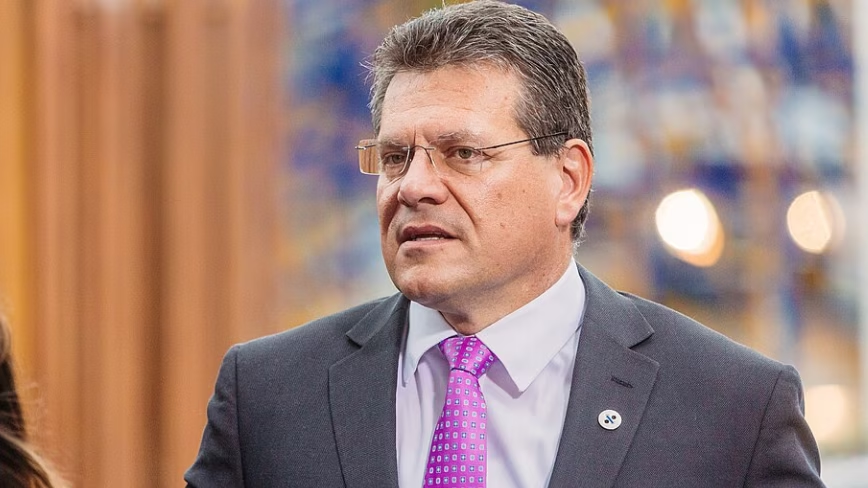
EU trade chief Šefčovič wants a new law forcing companies in sensitive sectors to have at least three suppliers, modelled on the Energy Union.
EU trade commissioner Maroš Šefčovič has called for a new “diversification instrument“ to reduce Europe's dependence on single suppliers of chips and rare earths. He made the proposal at the European Policy Center's Brussels Economic Security Forum on Friday. The tool would force companies in sensitive sectors to source from at least three different suppliers.
“If it's critical supplies, you have to have three different suppliers to make sure that you cannot be punished because of a political reason,” Šefčovič said. He cited the Energy Union as his model, an initiative he previously led to wean Europe off Russian energy after the 2014 annexation of Crimea.
The urgency is real. The EU relies on China for more than 90% of its rare earth supplies. Beijing imposed export controls on rare earth magnets last October during a tariff dispute with the United States, and halted chip shipments from Chinese-owned Nexperia after the Dutch government seized control of the company.

The 💜 of EU tech
The latest rumblings from the EU tech scene, a story from our wise ol' founder Boris, and some questionable AI art. It's free, every week, in your inbox. Sign up now!
Those disruptions hit European carmakers and exposed the bloc's vulnerability. “Recent industrial cases, in particular supplies of chips and rare earths, have reinforced my conviction that a step change is necessary,” Šefčovič said. “Every high-risk sector must be weaned off single-supplier dependence.”
The EU has since joined forces with Washington and other nations to find alternative sources. Sweden's discovery of Europe's largest rare earth deposit offered a long-term glimmer, but mining timelines stretch well beyond a decade. In the meantime, Europe remains exposed.
The proposal comes a day after Šefčovič urged Brussels and Beijing to address the EU's “unsustainable” trade deficit with China. That deficit widened to €360 billion last year, up 18% from 2024. EU leaders are set to discuss China's industrial overcapacity and subsidised exports at a summit on 18-19 June.
Šefčovič will also meet Chinese counterpart Wang Wentao in Brussels later this month. He told reporters the next step is a formal legal proposal. “We have to specify what to really do with the legal proposal,” he said.
The broader push to reduce chip dependency has already produced the EU Chips Act, which aims to double Europe's share of global chip production to 20%. A Chips Act 2.0 was proposed by the Commission in June 2026 with new measures to cut strategic dependencies further.