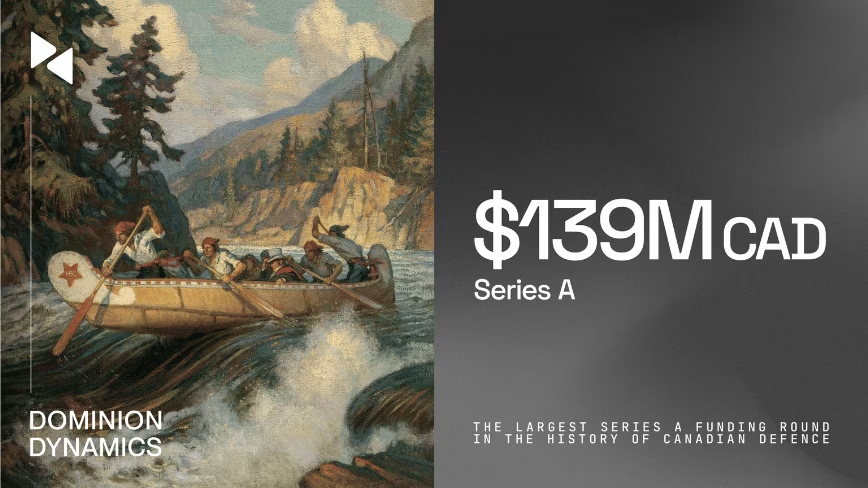
Canada just produced the biggest Series A in its defence history. The money is going into autonomous drones and the software to run a war in the Arctic.
Dominion Dynamics, an Ottawa defence-technology company, has raised CA$139mn ($100mn) in a Series A round. The raise is the largest of its kind in Canadian defence history, the company said. Georgian, Canada's largest independent venture firm, led it. Dominion has now raised CA$169mn since it launched in June 2025.
The investor list reads like a roll-call of allied defence money. It includes Valor Equity Partners and Bessemer Venture Partners in the US, Lakestar and Expeditions in Europe, and Canadian names such as OMERS, RBC, and BDC, according to the announcement. The pitch that drew them is simple. Autonomy is about to reshape how NATO defends itself, and the Arctic is where the hardest version of that problem lives.
Software for a war in the cold
Dominion's flagship product is AuraNet. The software ties scattered sensors, communications, and people into a single operating picture. The company calls it an operating system for command and control.
Earlier this year, the Canadian Armed Forces put it to work. During Operation Nanook-Nunalivut, Canadian Rangers used AuraNet with Dominion's Arctic-hardened sensors across the High Arctic. The exercise ran for two months. Dominion paid for it itself, then folded what it learned back into the product.
The Arctic is a brutal test bed. Distances are vast, infrastructure is thin or absent, and the cold breaks equipment built for milder places. “Starting in the Arctic means starting with the hardest problem set on Earth,” said Eliot Pence, Dominion's founder and chief executive. His bet is that kit proven there will work anywhere.
Drones that fly with fighters
The second product is Scout, what Dominion calls an Autonomous Collaborative Platform. The idea is a Canadian-built drone that flies alongside crewed fighter jets and stretches their reach into remote areas. Over the past six months it has moved from concept into simulation and systems development. The new money will pay to speed up testing and hire the engineers to finish it.
That places Dominion inside a fast-moving field. European peers such as ARX Robotics and Alta Ares are racing to field autonomous systems, while Comand AI sells command software to militaries. The common thread is machines that act with less human input, and software that keeps a person in charge.
Canada tries to rebuild
The raise lands at a turning point for Canadian defence. Ottawa has met NATO's 2 per cent spending benchmark and signed up to the alliance's new 5 per cent target by 2035. It has published its first Defence Industrial Strategy and set up a Defence Investment Agency. The government has also pledged to steer 70 per cent of defence spending to Canadian firms, lift defence research by 85 per cent, and create 125,000 jobs.
Pence frames the company as a national project. “Canada once built technology the rest of the world wanted, then convinced itself that was someone else's role,” he said. “We started Dominion to show the capability never left.” The team he is building leans on that argument. Dominion has hired from Anduril, Tesla, Rheinmetall, Google, and Rivian, alongside veterans of the Canadian Armed Forces.
The growth is physical too. In June the company moved into a 25,000-square-foot manufacturing site in Kanata, Ontario, and opened a development office in Toronto. It plans to pass 100 staff by the end of the year. It also wants to open further offices in British Columbia, Quebec, and Nova Scotia.
A crowded, cash-rich moment
Defence tech is awash with money right now. In Europe, Germany alone has hoovered up most of the region's record defence funding, and Stark Defence reached a valuation above €3.5bn within two years of launching. Dominion's Series A is smaller than those mega-rounds. Its claim is different. It wants to own the Arctic, a region every NATO member cares about and few can operate in.
Whether a two-year-old company can build both the drones and the software to back that claim is the open question. The money now says a lot of serious investors think it can. Pence, for his part, is not hedging. “We don't intend to follow the current or take the easy way,” he wrote. “We intend to shoot the rapids.”