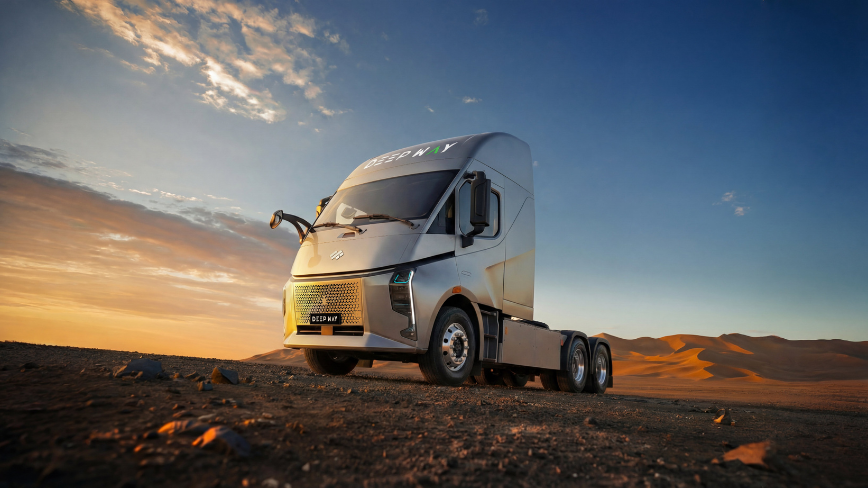
The Hefei-based company, which has delivered 6,400 intelligent electric heavy-duty trucks in China and is targeting a Hong Kong stock market listing, has attracted an Australian superannuation fund among its latest investors, a sign that its clean freight story is reaching institutional capital well beyond its home market. It has yet to turn a profit.
DeepWay, the Baidu-backed developer of intelligent electric heavy-duty trucks, has closed the second tranche of its pre-IPO financing, bringing the total raised in that phase to $310 million ahead of a planned Hong Kong listing.
The latest tranche was led by Stone Venture, with participation from NGS Super, an Australian superannuation fund for education-sector workers, and Xiamen Guosheng Fund. Existing investors ABC Impact, backed by Temasek, and Nanjing Ronghe Venture Capital also increased their stakes.
The involvement of NGS Super is notable. Australian superannuation funds managing retirement savings for hundreds of thousands of teachers and community workers do not typically lead the list of investors in pre-IPO rounds for Chinese autonomous vehicle startups.
That NGS Super participated signals either a conviction in the decarbonisation of heavy freight as a structural investment theme, or a broader search for returns in a market where domestic options look stretched, or both.
NGS Super's chief investment officer Ben Squires cited the company's “long-term investment value” and its potential to create a “sustainable commercial closed loop” in a statement, while noting the fund's “extensive resources in Australia and New Zealand” as a basis for supporting DeepWay's international ambitions.
DeepWay was founded in 2020 as a joint venture between Baidu and Lionbridge, a Chinese commercial vehicle services platform.
The company's thesis is straightforward but uncommon: rather than converting existing diesel truck platforms to electric power, the approach taken by most of the industry, DeepWay designed its vehicles from scratch for electric powertrains and built intelligent driving capabilities in from the outset.
Baidu, which holds a 17.28% stake in the company according to its prospectus, provides the foundation via its Apollo autonomous driving technology, which DeepWay is authorised to access and modify under what the two companies describe as an exclusive commercial vehicle arrangement. The company then layers its own driver assistance and platooning systems on top of that base.
The commercial results so far are rapid, if not yet profitable. DeepWay delivered 509 vehicles in 2023, 3,002 in 2024, and 2,873 in the first half of 2025 alone, roughly 6,400 units in total as of June 2025, all from commercial customer orders.
Its H1 2025 revenue was approximately CNY 1.5 billion (around $200 million), according to its Hong Kong listing prospectus. But it has not achieved profitability: the prospectus records a net loss of CNY 675 million ($97 million) for the full year 2024, and CNY 371 million ($53 million) in H1 2025.
The company has said it expects to continue incurring losses as it ramps up research and development, sales, and overseas operations.
The listing itself, filed with the Hong Kong Stock Exchange in November 2025 with CICC and CMB International as joint sponsors, is expected to proceed under the city's Chapter 18C listing regime, which allows specialist technology companies that cannot meet standard financial eligibility tests to go public provided they meet minimum capitalisation thresholds.
The regime has been used by a growing number of Chinese autonomous driving and EV companies since it was introduced in 2023. WeRide and Pony.ai listed in Hong Kong in October 2025; LiDAR maker Hesai raised $531 million there a month earlier.
DeepWay's technology stack spans two tiers. At the driver assistance level, its Tianji Suixing system is now standard across its entire vehicle lineup, with operators paying a subscription fee for active use.
At the higher-autonomy level, Tianji Yanxing, its intelligent platooning system, is already operational in cargo-carrying runs in multiple Chinese regions and has begun delivering commercially.
The company has obtained autonomous driving test permits in Beijing, Hefei, Changxing, and Inner Mongolia. The stated end goal is fully autonomous freight robots, trucks that require no human operator at all, though the timeline for that remains unspecified.
The proceeds from both pre-IPO tranches will fund core operations, technology development, and global expansion. DeepWay has established sales networks in Singapore, Thailand, Malaysia, the UAE, Oman, Australia, and New Zealand, and completed overseas deliveries by the end of 2025.
The company's global road freight market context is significant: the industry is worth an estimated $3.9 trillion and remains overwhelmingly dependent on diesel, making it both a major emissions contributor and a target for investors betting on the long-term economics of electrification.
As we have previously reported, Western autonomous trucking companies such as Einride are pursuing similar strategies in the Middle East, a region DeepWay is also targeting. The difference is that DeepWay has already delivered thousands of working trucks commercially, while most of its Western peers are still at smaller-scale pilot stages.