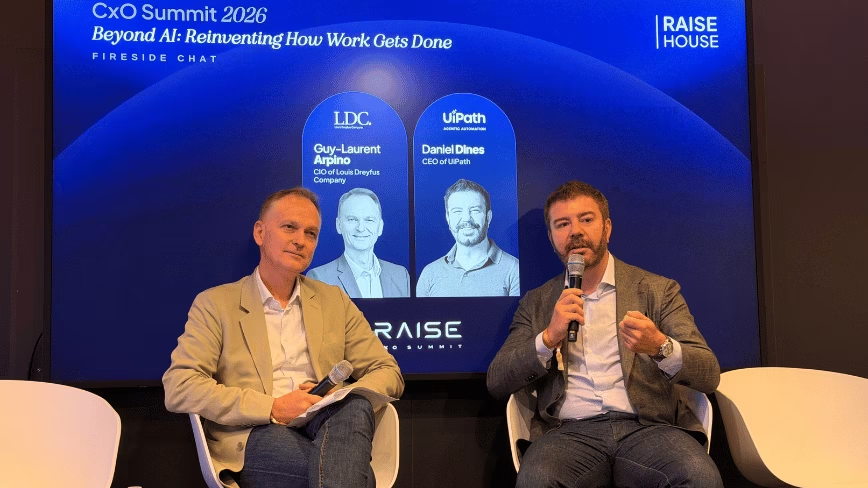
At the Raise summit in Paris, two enterprise leaders asked why AI agents keep stalling in pilots. Their fix starts with people, not models.
Most enterprises stall. Their AI agents run in pilots and never reach production. That was the blunt diagnosis from Daniel Dines, chief executive of UiPath. He spoke at the RAISE CxO Summit in Paris this week.
Dines took aim at the industry's hype. The promise of a “country of geniuses” that behaves like a human employee does real harm, he argued. He called it “a big disservice to the entire AI industry”. You cannot hire an AI, hand it a laptop, plug it into your systems, and expect it to replace everyone.
He offered a cooler forecast. “AI is not going to become human-like,” he said. It may reach a form of AGI, but it will not think or learn the way people do. So enterprises need a new division of labour.
AI proposes, humans decide

The 💜 of EU tech
The latest rumblings from the EU tech scene, a story from our wise ol' founder Boris, and some questionable AI art. It's free, every week, in your inbox. Sign up now!
Dines framed it as a simple triad: AI proposes, humans decide, and automation executes. The catch is the proposal. A trivial one wastes people's time. A buggy one takes longer to fix than the job itself. That gap, he said, is why so many pilots stall.
The deeper problem is knowledge. Humans learn a job by connecting scattered clues, from emails and tickets to a quick word with a colleague. No company keeps all of that in one place, and AI cannot absorb it the same way.
So Dines floated a new role: the “cartographer”. Their task is to draw a “map of work” for AI. That map sets out the business entities, the actions available, and the consequences. Who is accountable when an agent makes a payment? Can anyone roll it back? Today, he said, no one writes that knowledge down.
The organisation is the hard part
Guy-Laurent Arpino, chief information officer of Louis Dreyfus Company, agreed, but added a caveat from experience. The hardest part of any transformation is the organisation, not the technology.
The commodity-trading giant spent years cleaning its data and codifying the know-how in its traders' heads. That context now lives in “craft databases” and knowledge drives, and Arpino calls it “a true IP of our company”. Only on top of it can agents work reliably. “The worst enemy of AI agents is unreliability,” he said.
LDC now rebuilds its core “contract-to-cash” flow end to end, from trade capture to logistics to payment. Some of it leans on older automation the firm built with UiPath. The rest defines where agents fit and where humans must step in.
Less passengers, more drivers
Both men kept returning to people. Dines thinks one human trait will outlast the automation wave: will. “I don't really see AI coming with the will of itself,” he said. Enterprises run on countless human initiatives, so the future belongs to “less passengers and more drivers”.
The risk sits in the middle. Senior leaders back the shift, and young staff adopt it fast, but middle managers can freeze between the two. LDC runs a “champions” programme that arms its youngest employees with the newest tools, pushing innovation up from the bottom.
Why it matters
The pair saved their sharpest warning for hiring. Junior recruitment has slowed sharply in the past 18 months, and Dines called that a mistake. Cut the pipeline, he said, and you starve the enterprise of its future leaders. His answer echoes his earlier warning against cutting too fast: senior staff must become mentors.
Arpino agrees, and says LDC keeps hiring juniors despite the churn in entry-level roles. The trick, he admits, is to train them without slowing AI down. The technology races ahead. The slower, harder job is to teach a company, and its people, to keep up. That tension defined Raise this week.
Europe's AI ambitions shared the stage with its doubts, including whether AI will deliver the growth its boosters promise.