TL;DR
ContourGlobal has inaugurated a $500 million solar-and-storage plant in Chile's Atacama desert that delivers 200 megawatts of power for up to 6.5 hours at night. Chile has 3,072 MW of battery storage operating and expects an additional 5,400 MW by December 2026.
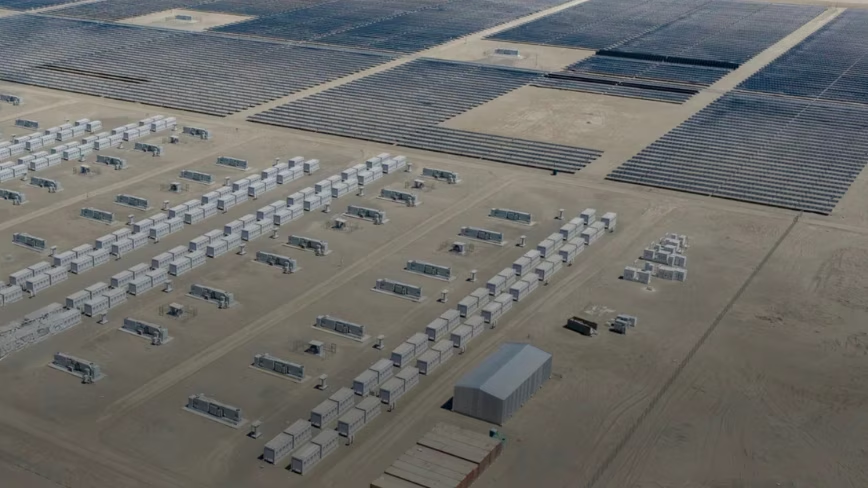
ContourGlobal, the independent power producer backed by KKR, has inaugurated a nearly $500 million solar-and-storage facility in Chile's Atacama desert that stores daytime solar energy and delivers it after sundown. The Victor Jara hybrid plant combines 231 megawatt-peak of photovoltaic capacity with 1.3 gigawatt-hours of battery storage, capable of delivering 200 megawatts of power for up to 6.5 hours at night. ContourGlobal calls it Latin America's longest-duration utility-scale battery system.
The project sits in the Tarapacá region and is backed by a 15-year nighttime power purchase agreement with Copec EMOAC, the energy marketing and renewable power supply arm of Empresas Copec, one of Chile's largest industrial conglomerates. It is ContourGlobal's second solar-and-storage investment in Chile, following the launch of a similar system in Quillagua in the neighbouring Antofagasta region last year. Together, the two projects deliver 452 megawatt-peak of solar and 2.5 gigawatt-hours of battery storage.
Why the Atacama
The Atacama desert receives some of the highest solar irradiance on Earth, making it one of the most productive locations in the world for photovoltaic generation. The problem is that the sun produces more electricity during the day than Chile's grid can absorb, resulting in routine curtailment, wasted energy from solar plants that are forced to shut down because there is nowhere for the power to go. Transmission bottlenecks between the solar-rich north and the demand centres further south make the problem worse.
Battery storage solves this by absorbing excess solar generation during the day and discharging it at night, effectively turning an intermittent energy source into a dispatchable one. Solar-plus-storage projects are increasingly being designed to serve round-the-clock power needs, including the growing demand from data centres that require constant, predictable supply.
James Lee Stancampiano, ContourGlobal's South America general manager, said Chile is the place to be in Latin America, citing the country's regulatory framework, growing electricity demand, and pipeline of renewable energy and storage investments. The company is evaluating additional projects in Chile, including developments closer to the capital Santiago and wind projects in the central and southern regions.
A storage boom in numbers
Chile currently has 3,072 megawatts of battery energy storage capacity either operating or undergoing testing, with most projects concentrated in the Atacama desert, according to the Coordinador Eléctrico Nacional (CEN), the national grid operator. CEN projects the start-up of an additional 5,400 megawatts of storage capacity by December 2026. Battery energy storage systems now make up nearly 42% of Chile's energy project pipeline by capacity, the largest single category.
The investment is not coming from a single player. AES Andes, Engie Energía Chile, and Enel Green Power Chile all have storage projects in the country. Atlas Renewable Energy, backed by BlackRock's Global Infrastructure Partners, secured $510 million in financing last year for its hybrid Estepa project, one of Chile's largest solar-plus-storage developments. Grenergy, the Spanish developer, is building the Oasis de Atacama complex, which it describes as the world's largest solar-plus-storage project.
Mining, data centres, and the demand driver
What makes Chile different from other solar-rich markets is its industrial demand profile. The country's mining sector, which produces roughly a quarter of the world's copper and a significant share of its lithium, is one of the most energy-intensive industries on the planet. Mines operate around the clock and need reliable, predictable power. They are also under increasing pressure from customers, regulators, and investors to decarbonise their operations.
Antonio Cammisecra, ContourGlobal's CEO, said the presence of a highly energy-intensive industrial base, particularly mining, has driven demand for reliable, long-term renewable power. He framed storage as the technology that shifts renewables from intermittent sources into programmable energy solutions, a transformation he called essential for reducing system costs, accelerating decarbonisation, and replacing conventional generation at scale.
Data centres are the emerging demand driver. The global push to electrify everything, from industrial processes to AI compute, is creating new markets for round-the-clock renewable power. ContourGlobal expects growing demand from data centres that need large amounts of always-on electricity, and Chile's combination of cheap solar, storage infrastructure, and political stability makes it a credible location for facilities that would otherwise be built in the US or northern Europe.
The model that could scale globally
Chile's approach, building massive solar capacity in the desert, pairing it with battery storage, and selling nighttime power under long-term contracts, is a model that other solar-rich regions are watching closely. The economics are compelling. Solar generation costs continue to fall, battery prices have declined by roughly 90% over the past decade, and the combination of the two is now competitive with or cheaper than new gas-fired generation in most markets.
The 15-year nighttime PPA structure used by ContourGlobal is particularly noteworthy. It de-risks the battery investment by guaranteeing revenue for the discharge cycle, making the storage component financeable on project finance terms rather than merchant risk. This is the kind of contractual innovation that unlocks institutional capital for storage at scale.
Hybrid renewable energy projects are becoming the standard rather than the exception. Chile's Atacama desert is the most advanced laboratory for this transition. By the end of 2026, the country will have more than 8,400 megawatts of battery storage capacity online, enough to make it one of the largest storage markets in the world, built in a desert that until recently was known primarily for astronomy and copper.