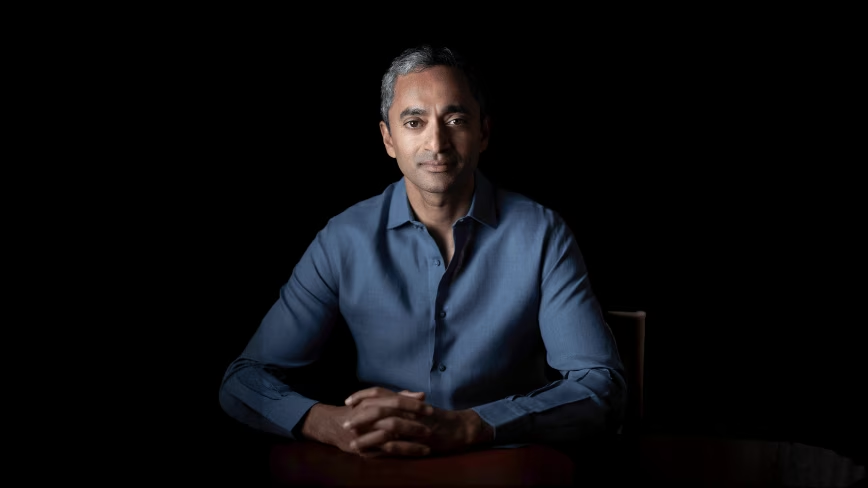
On The Axios Show, Chamath Palihapitiya said Meta “fumbled” its lead in AI, dismissed the jobs apocalypse, and finally called his SPAC incentives “grossly misaligned.” Here is what the investor told Axios.
Chamath Palihapitiya does not do quiet interviews. On The Axios Show, the investor and All-In podcast co-host ranged across Meta's AI stumble, the future of work, his own SPAC regrets and the limits of online privacy. His views matter. They carry weight in the White House and with hundreds of thousands of podcast listeners. Few investors swing as freely between tech, markets and politics.
Palihapitiya is an unusual messenger. He is an immigrant, a Trump supporter and a former Facebook executive who helped build the company. That mix gave the conversation an edge. He did not spare his old employer.
Meta “fumbled” its AI lead
He saved his sharpest words for Facebook. The company “completely fumbled” a huge chance to lead in AI, he told Axios' Dan Primack. He even said it had “profoundly failed.”

The 💜 of EU tech
The latest rumblings from the EU tech scene, a story from our wise ol' founder Boris, and some questionable AI art. It's free, every week, in your inbox. Sign up now!
The critique stings because of his history. Back in 2022, before ChatGPT launched, Palihapitiya argued Meta held a strong position in AI. The company knew so much about its users. It had the data and the reach to match.
Then the moment arrived, and Meta missed it. When chatbot mania hit, Facebook had the distribution to push AI products to billions of people at once. It could have become the champion of open-weight AI. Instead, he argued, Nvidia and Jensen Huang read the moment better and built the ecosystem around open models.
He framed the AI market as three pillars. One pillar covers the closed American labs, OpenAI and Anthropic. Another holds China's cheaper open-weight challengers, led by DeepSeek. The third stood there for Meta to take: the open-source, open-weight American lab. Meta's Llama models count as open weight, not fully open source. He believes the company failed to own that lane, and it now leans toward proprietary models instead.
He declined to guess why. Palihapitiya said he does not know enough about Meta's internal decisions to explain the stumble. He just sees the result.
The stakes are large. Meta has poured billions into AI research and talent. Yet his point is about position, not spend. The company that mastered social distribution, he argued, failed to turn that edge into AI leadership.
No jobs apocalypse
On work, he pushed back hard against the doom. The idea that AI will erase jobs makes an “incredible headline,” he said. But he thinks it ignores history.
Primack floated a future where robots even do the plumbing. Palihapitiya's answer was simple. Who runs the plumbing business? Who runs the robotics company? People still need shelter, food, clothing and, yes, bathrooms.
“I think it's great to spark a debate,” he said. But he argued the fear ignores the “patterns of the past.” Old technologies let humans do more, not less.
“I suspect if you just trend it, that 35 things now goes to 300 things over the next thousand years,” he said. “There's going to be more ways in which we allocate time.” When Primack worried about his teenage daughter, Palihapitiya pushed back. Did he really think she would end up “unemployed and a ward of the state”?
Others have reached the same view. OpenAI's Sam Altman has said a jobs apocalypse is unlikely, walking back earlier warnings. He still concedes that some categories, such as customer support, will largely disappear. The shift is broad, with Big Tech bosses flipping from doom to reassurance. MIT researchers have called AI automation a “rising tide” rather than a “crashing wave.” The mood among AI leaders has cooled from panic to caution.
A rare SPAC mea culpa
The most striking moment turned personal. Palihapitiya, once dubbed the “SPAC King,” finally agreed with his critics.
“The most important thing I learned was that my incentives were grossly misaligned,” he said. He admitted he had resisted the point for years. “I was too insecure to admit it.” The problem came down to one thing. He could do a deal and still get paid, whatever happened next.
He did not disown his deals entirely. “I don't think I did bad deals in the way I underwrote them,” he said. “But I think the stock performance is what the stock performance is and that's undeniable.” His SPACs produced one winner, SoFi, and painful losers like Virgin Galactic and Clover Health.
This is a change of tune. In 2022 he blamed poor SPAC returns on a market warped by years of near-zero interest rates. Now he owns the structure itself.
He has a new vehicle, American Exceptionalism Acquisition Corp, and a new design. His shares only vest if the merged company trades 50% above its listing price, or roughly $15 a share. That ties his payout to investor returns, the very link his old deals lacked. He hinted a target is in sight, though due diligence is not done. The timing fits a second SPAC boom. By one count, 251 blank-cheque firms are hunting for targets, with nearly $47bn between them. Another 110 mergers are already in train.
Privacy, Trump and what comes next
He also waded into privacy. AI companies, he suggested, should sometimes know who you are and what you are prompting. It is a provocative line in a field built on anonymity. It hints at how he sees safety and accountability evolving as the technology spreads.
He defended President Trump's immigration policies too, speaking as an immigrant himself. And he is not just talking. Palihapitiya now runs an AI startup called 8090, so his bets on the technology are his own, not only commentary.
Taken together, the interview is classic Chamath. He is contrarian on jobs, harsh on Meta, newly humble on SPACs and comfortable near power. The full episode lands later this week. Whether his three-pillar map of AI holds, and whether Meta can still claw back the lane he says it lost, is the question hanging over it all.