TL;DR
BYD denies environmental breaches at its Szeged factory as Hungarian police probe toxic soil claims and the company scouts a second European plant.
BYD rejects claims it violated Hungarys environmental rules at its Szeged EV factory
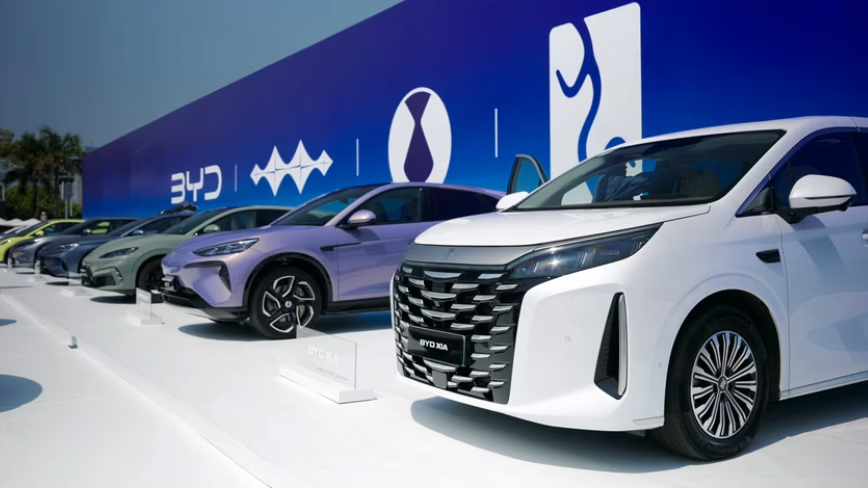
BYD denies environmental breaches at its Szeged factory as Hungarian police probe toxic soil claims and the company scouts a second European plant.
BYD executive vice president Stella Li said the Chinese automaker has complied with all environmental regulations at its Szeged factory in Hungary, pushing back against allegations that the company violated its obligations during construction. Li made the comments at a press conference in Belgrade on Friday, where she met with Serbian President Aleksandar Vucic to discuss a potential second European production site.
The denial comes after Hungary's environment minister said in May that BYD had “seriously violated” its environmental obligations at the Szeged site, where Hungarian police are investigating whether toxic soil was improperly handled during construction work. The government imposed a fine of 10 million forints, roughly $27,000, on the company over the incident.
BYD began trial production at the Szeged plant in early 2026 and plans to start full assembly operations in the fourth quarter. The factory is the first major Chinese automaker production facility in Europe, a milestone that has drawn both investment interest and political scrutiny. Hungary positioned itself as China's gateway into the EU under former Prime Minister Viktor Orban, capturing 44% of all Chinese foreign direct investment into Europe in 2023.
The political landscape has since shifted. Peter Magyar, who replaced Orban earlier this year, has taken a harder line on environmental and labour standards at Chinese-backed projects. The scrutiny of BYD's Szeged site is part of a broader review that has also targeted battery manufacturers CATL and Samsung SDI, both of which operate or are building large facilities in Hungary.

The 💜 of EU tech
The latest rumblings from the EU tech scene, a story from our wise ol' founder Boris, and some questionable AI art. It's free, every week, in your inbox. Sign up now!
However, subsequent testing has complicated the initial allegations. According to Hungary Today, later soil tests on surrounding farmlands found no contamination above regulatory limits. The distinction matters: the police investigation centres on whether soil from the construction site itself was improperly disposed of, not whether the factory is actively polluting surrounding land.
Li's appearance in Belgrade served a dual purpose. Beyond addressing the environmental controversy, she was there to discuss BYD's search for a second European plant. Bloomberg reported that BYD is open to buying an existing facility, partnering with another manufacturer, or building from scratch.
Vucic offered Serbia as a production site during the meeting, pitching the country's lower labour costs and proximity to EU markets.
The second-plant search has also involved conversations with Stellantis, according to Bloomberg. The Franco-Italian automaker has excess factory capacity across Europe, and a deal would give BYD immediate production infrastructure without the multi-year timeline of a greenfield build. European EV demand has surged in 2026, with battery-electric registrations jumping 51% in March alone, creating urgency for Chinese manufacturers to localise production and avoid EU import tariffs.
The Szeged controversy sits within an even broader pattern of scrutiny. China Labor Watch and other organisations have raised separate allegations of forced labour practices at the construction site, claims that BYD has denied. The European Parliament has also flagged labour conditions at Chinese-backed projects in Hungary, adding another dimension to the political pressure on Magyar's government to demonstrate tighter oversight.
For BYD, the stakes extend well beyond a $27,000 fine. The company overtook Tesla as the world's largest seller of battery-electric vehicles in 2025 and is racing alongside other Chinese automakers to establish European manufacturing before tariff walls rise further. Any sustained regulatory friction in Hungary could complicate its expansion plans at a moment when the European market is its fastest-growing opportunity.
Li told reporters in Belgrade that BYD will continue to invest in Hungary and cooperate fully with the investigation. Whether that cooperation satisfies Magyar's government, which has political incentives to distance itself from Orban's permissive approach to Chinese investment, remains the open question.