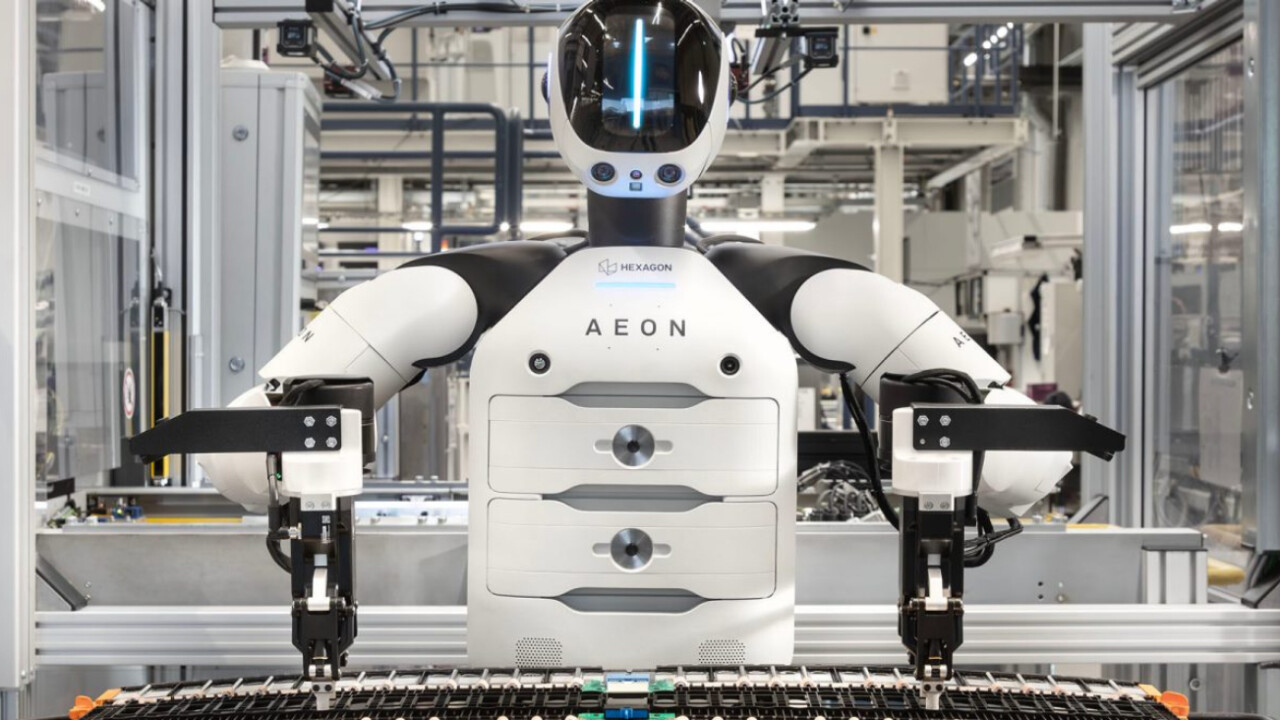
A new colleague has arrived on the shop floor at BMW's Leipzig plant. It stands 1.65 metres tall, weighs 60 kilograms, and instead of feet, its legs end in wheels. Its name is AEON, and it represents something genuinely new for European manufacturing: the first humanoid robot deployed in production in Germany.
BMW Group announced the Leipzig pilot on 9 March 2026, framing it as the latest step in what the company calls its ‘physical AI' strategy, the convergence of artificial intelligence and robotics at the level of the factory floor. The robot is built by Hexagon Robotics, the physical AI division of Swedish measurement technology group Hexagon, headquartered in Zürich.
The timing is notable. The executive leading this initiative, Milan Nedeljković, BMW's Board Member for Production, has been named the company's incoming CEO, effective 14 May 2026. His promotion was announced in December 2025, making the Leipzig deployment one of the last major announcements from his tenure as production chief, and an early signal of the priorities he will bring to the top job.
What AEON actually does

The 💜 of EU tech
The latest rumblings from the EU tech scene, a story from our wise ol' founder Boris, and some questionable AI art. It's free, every week, in your inbox. Sign up now!
AEON is not a legged humanoid in the conventional sense. Rather than feet, its legs terminate in wheels, allowing it to move across factory floors at up to 2.5 metres per second on flat surfaces, while retaining the ability to step over obstacles when needed. Its torso is human-like, designed to accept interchangeable gripping tools, hands, and scanning devices without structural modification, making it genuinely multifunctional in a way that fixed-arm industrial robots are not.
The robot carries 22 integrated sensors, including peripheral cameras, time-of-flight, infrared, SLAM navigation cameras, and microphones, giving it 360-degree real-time spatial awareness. It runs on NVIDIA Jetson Orin onboard computers and was trained largely through simulation using NVIDIA's Isaac platform, a method that allowed Hexagon to develop core locomotion capabilities in weeks rather than the months a traditional approach would require.
At Leipzig, AEON's initial role is to support high-voltage battery assembly and component production, areas where tasks are repetitive, physically demanding, and require precision. The operational debut took place in December 2025, following a theoretical assessment and laboratory testing phase. Further testing is planned for April 2026, ahead of full pilot integration scheduled for summer.
“Our aim is to be a technology leader and integrate new technologies into production early,” said Michael Nikolaides, Senior Vice President Production Network, Supply Chain at BMW Group. “Pilot projects help us test and evolve the use of adaptive AI-enabled robots, also known as ‘physical AI', in a real-world industrial setting.”
Hexagon's unusual approach to humanoid robotics
Hexagon is not a name typically associated with humanoid robots. The Stockholm-listed group — which reported revenue of around €5.1 billion in 2024, built its reputation over decades in precision measurement technology, sensors, and industrial software. Its Robotics division, formed specifically to develop AEON, launched the robot at Hexagon's annual Hexagon LIVE Global event in Las Vegas in June 2025.
The AEON project was built in collaboration with NVIDIA, Microsoft, and precision actuator maker Maxon. NVIDIA's accelerated computing infrastructure powers training; Microsoft Azure enables scalable model development; and Maxon's next-generation actuators drive locomotion. Arnaud Robert, President of Hexagon Robotics, has described the robot's design philosophy as explicitly industrial: it is built to work, not to perform. “We're not in the dancing business, we're in the working business,” he said at a Munich event earlier this month attended by automotive press.
BMW describes Hexagon as a longstanding partner in sensor technologies and software, which gave the two companies a natural foundation for the joint robotics programme. The Leipzig pilot is the first automotive deployment of AEON anywhere in the world; Hexagon's other announced pilot partners include aerospace manufacturer Pilatus and bearing and components specialist Schaeffler.
The Spartanburg precedent
BMW's decision to bring AEON to Leipzig builds directly on a prior experiment across the Atlantic. In January 2024, BMW announced a commercial agreement with Figure AI, a California-based humanoid robotics startup, to deploy robots at its Spartanburg plant in South Carolina, which assembles the X3, X5, X7, and related models. Initial testing began shortly after, with a formal results announcement in August 2024 and the full 11-month deployment completing in late 2025.
The numbers from Spartanburg are striking. Figure 02, a legged humanoid operating on 10-hour shifts five days a week, handled the removal and positioning of sheet metal parts for the welding process, moving more than 90,000 components over approximately 1,250 operating hours and contributing to the production of more than 30,000 BMW X3 vehicles. The robot logged roughly 1.2 million steps during that period.
The project also surfaced practical lessons that BMW and Figure are now folding into next-generation systems. The transition from laboratory to live production was faster than anticipated. Revised safety protocols, including additional barriers and improved 5G connectivity in the production hall, were implemented as the deployment progressed. Figure 02 has since been retired as Figure AI moves to its third-generation platform, Figure 03, which BMW and Figure are now evaluating for potential new deployments.
Both the Spartanburg and Leipzig programmes reflect a broader strategic bet BMW is making on the role of AI in manufacturing, and on the premise that humanoid robots, specifically, are approaching the threshold of genuine industrial usefulness.
BMW's iFACTORY concept, its overarching vision for production, rests on three pillars: lean, green, and digital. The digital pillar has involved a systematic conversion of the group's production systems toward a unified IT and data model, breaking down the data silos that previously separated different functions, and creating a shared platform across which AI agents, digital twins, and autonomous transport systems can all operate.
The humanoid robot sits at the frontier of that programme: it is the physical layer of a system that is otherwise increasingly virtual.
“Digitalisation makes our production more competitive, both here in Europe and worldwide,” said Nedeljković in a statement. “This symbiosis of engineering expertise and artificial intelligence opens up entirely new opportunities in production.”
BMW has also established a dedicated Centre of Competence for Physical AI in Production, bringing together specialists in AI and robotics to evaluate technology partners and oversee the progression of pilot projects from the concept stage through to operational deployment. The modular physical AI solutions developed there are intended to be rolled out across BMW Group plants globally.
For employees, BMW is careful to frame humanoid robots as a complement to human labour rather than a replacement for it. Repetitive, ergonomically demanding, or safety-critical tasks are the target, freeing workers to focus on quality control, process management, and the integration of new technologies.