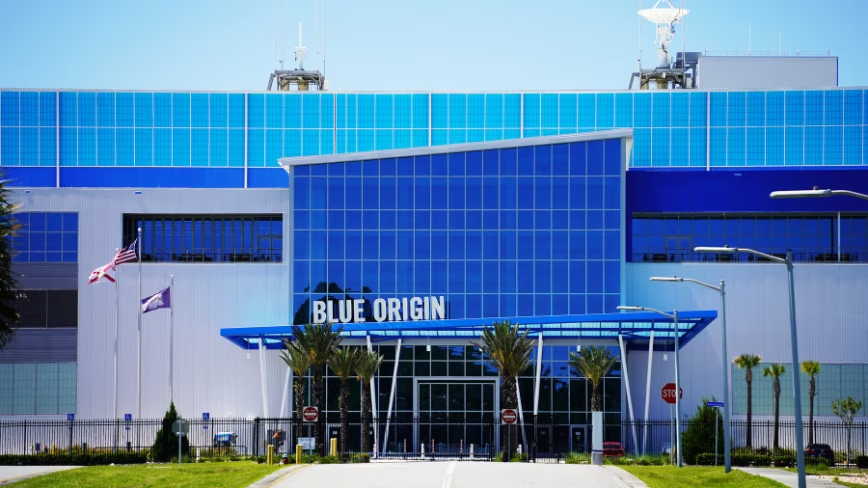
Project Horizon adds an 830,000-square-foot upper-stage factory at Cape Canaveral, weeks before SpaceX's record IPO and a month after the April New Glenn payload mishap.
Blue Origin will spend $600m on a new upper-stage manufacturing facility at its Rocket Park campus in Cape Canaveral, Florida governor Ron DeSantis announced on Friday.
The building, branded Project Horizon, will run to 830,000 square feet and add 500 aerospace jobs at an average salary of more than $98,000. It is the most ambitious single expansion the company has booked in the state in its decade there.
The announcement landed on a deliberately well-chosen day. The Federal Aviation Administration cleared New Glenn to fly again after the April NG-3 mission lost an AST SpaceMobile satellite when an upper-stage thermal anomaly cut one engine's thrust below spec.

The 💜 of EU tech
The latest rumblings from the EU tech scene, a story from our wise ol' founder Boris, and some questionable AI art. It's free, every week, in your inbox. Sign up now!
The booster itself landed cleanly on the droneship “Jacklyn”. Project Horizon is, in plain reading, the long-form answer to the question the April loss prompted: whether Blue Origin can manufacture the upper stages it now needs at the cadence its order book has begun to require.
Dave Limp, the company's chief executive, framed the project that way in a statement, calling it “the latest and most ambitious chapter in Blue Origin's decade-long commitment to Florida”.
Limp said the company has scaled to nearly 4,000 employees and invested more than $2.3bn across 500 Florida suppliers since 2015. Florida's Spaceport Improvement Program, a joint vehicle of Space Florida and the state Department of Transportation, will support the project; the same programme funded Blue Origin's new pad at Launch Complex 36.
The competitive backdrop is unmistakable, and Reuters made the point unprompted. Elon Musk's SpaceX is preparing for what is on track to be the largest IPO in history, with the prospectus targeting a $1.75tn valuation and a June listing. T
hat sits against a Blue Origin that has spent twenty-five years as a privately held vehicle for Jeff Bezos's cheques and only recently begun taking outside money to fund its build-out. The two companies are no longer competing on the same terms; the question is whether industrial capacity, rather than capital markets, can keep Blue Origin in the conversation.
Florida is increasingly where that question gets answered in practice. Blue Origin is, as the company noted, currently the only firm that both manufactures and launches rockets from the state. SpaceX manufactures in Texas and California; ULA assembles in Alabama.
The Project Horizon factory consolidates the upstream end of Blue Origin's heavy-lift operation in the same county as the launch pad, which removes the transport step that has historically been the bottleneck for large boosters and upper stages.
The upper-stage focus is itself revealing. New Glenn's upper stage is the surface on which the April failure played out, and the section that has consistently lagged the booster in Blue Origin's flight programme. The new factory specialises in that piece.
Limp's statement said the facility “will increase the volume and mass that can be delivered into orbit”, which is, in the dry idiom of company comms, an acknowledgement that the constraint sits in the upper stage rather than the first.
DeSantis, for his part, used the announcement to repeat the state's preferred framing: aerospace as the through-line in Florida's industrial strategy. The state has now backed Blue Origin's pad infrastructure, its hypergolic fuelling facility, and now its upper-stage factory through the Spaceport Improvement Program.
The next decision sits with Blue Origin: how quickly the building actually rises, and how quickly the upper stages coming out of it fly.