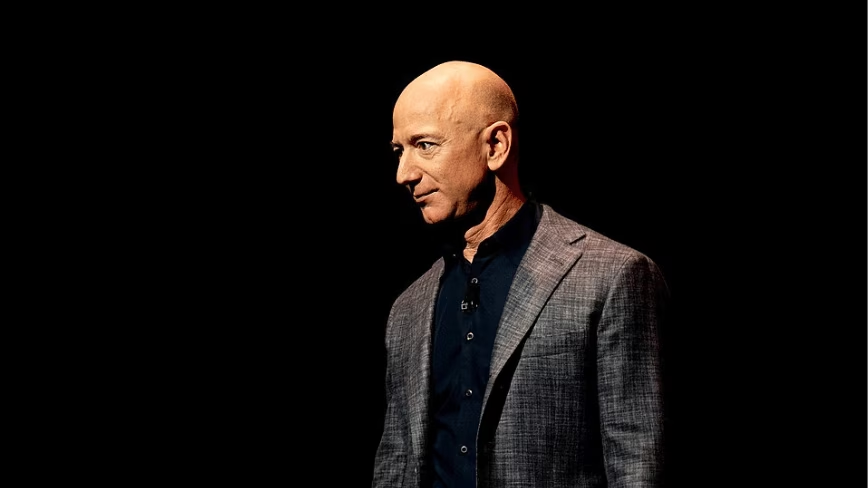
Jeff Bezos has found a new place to advertise Amazon's artificial intelligence, and it happens to be the screen where you were hoping to watch a film.
Amazon's executive chairman is pushing a redesign of Prime Video, known internally as Lighthouse, meant to turn the streaming service into a high-profile showcase for the hundreds of billions of dollars the company has spent on AI, Reuters reported on Thursday.
It is the same instinct that recently put Alexa inside the search bar on Amazon's shopping site.
The work is led by Prime Video head Mike Hopkins, with the unit's global design lead, Kam Keshmiri, running the project day to day.

The 💜 of EU tech
The latest rumblings from the EU tech scene, a story from our wise ol' founder Boris, and some questionable AI art. It's free, every week, in your inbox. Sign up now!
The problem it is chasing, helping people find something to watch without endless scrolling, is the same one Netflix has thrown generative AI at, and it gained urgency after Bezos pushed back at an internal presentation, telling the team its plans did not lean hard enough on AI.
Bezos has since been taking regular updates on the work, according to the reporting, and an earlier set of designs was scrapped once the team was told to start again with AI at the centre.
That level of founder attention is unusual for a product feature, and it tells you how much weight Amazon is placing on being seen to have something to show for its spending.
According to the reporting, Lighthouse would rebuild the home screen around machine-generated recommendations rather than a fixed grid.
Features under development include AI-generated thumbnails, pre-filled browsing prompts such as “1980s action films” and “Christmas rom-coms”, and voice search powered by Alexa. Conventional search would stay, for anyone who already knows what they want.
The change carries a commercial edge that studios will notice. Prime Video currently sells fixed, premium placement slots on its home screen, the digital equivalent of an end-cap in a supermarket.
Lighthouse would trim those in favour of algorithmic ranking, which unsettles the arrangements studios have relied on to buy their way into a viewer's eyeline.
In practice, that turns a guaranteed placement into a contest an algorithm decides. Studios that once paid for a fixed spot would instead be ranked alongside everything else on offer, with the personalisation engine choosing who sees what.
For partners used to negotiating visibility, a marketplace they cannot fully see into is a harder thing to plan around.
The prize is reach. Prime Video claims more than 200 million monthly viewers, yet it drew roughly 4.2% of US television viewing time in recent figures cited by Reuters, well behind YouTube on about 13.4% and Netflix on close to 7.8%, and behind Disney+ too.
A home screen seen that often is a useful billboard for a company trying to prove its AI spending has a point.
None of this is Amazon's first pass at the idea. A 2024 redesign already added “Made for You” collections and synopses trimmed by large language models running on AWS, and the company has been folding generative AI into recaps and dubbing for a while.
The technology has also proved legally awkward, as the Nova Reel lawsuit brought by a group of YouTubers made plain.
The push also sits alongside Amazon's broader appetite for automation. The company is using AI to speed up film and television production through a small studio team run by executive Albert Cheng, which has already leaned on the technology for battle scenes in the biblical series House of David.
The same company has cut about 30,000 corporate jobs since October, citing AI among the reasons, and the bet that reshaped Alexa is now being aimed squarely at the living room.
Amazon is testing versions of Lighthouse with a selection of users, and the final layout has not been settled. Amazon declined to comment.
What Bezos wants is clear enough anyway, which is for the recommendation engine, not the catalogue, to be the first thing you see.