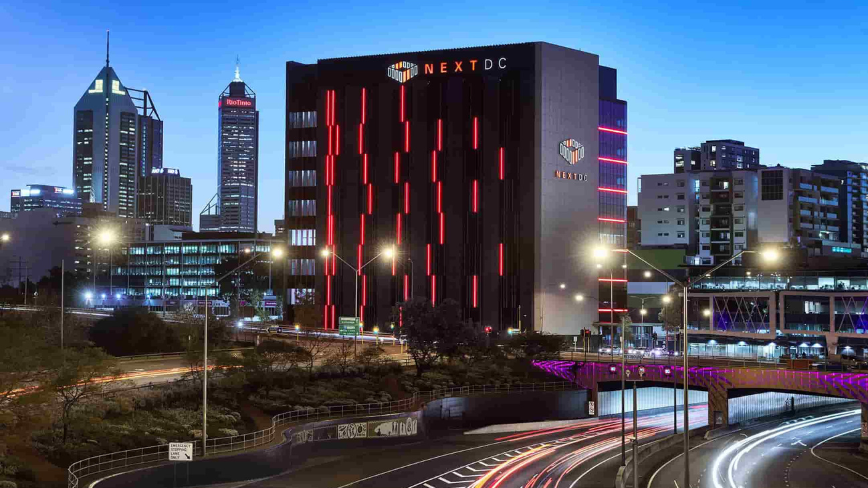
The ASX-listed data centre operator is raising A$1.5 billion in a fully underwritten equity offering and expanding its hybrid securities programme by A$700 million, with La Caisse de dépôt et placement du Québec now committed to a total of A$1.7 billion.
The raise will fund accelerated development of the S4 Western Sydney campus, where contracted utilisation jumped 250 megawatts in a single quarter.
NEXTDC (ASX: NXT), Australia's largest independent data centre operator, has halted trading to launch a A$2.2 billion capital plan anchored by a fully underwritten A$1.5 billion equity entitlement offer, the company announced on Monday.
The raise is a direct response to a step-change in demand: between December 2025 and 31 March 2026, NEXTDC's pro forma contracted utilisation jumped 250 megawatts, a 60% increase in a single quarter, to reach 667MW.
Its forward order book grew 83% over the same period to 544MW, driven by hyperscale cloud providers and AI infrastructure customers.
The equity component is structured as a 1-for-5.4 pro-rata accelerated non-renounceable entitlement offer, priced at A$12.70 per share, an 8.6% discount to the theoretical ex-rights price of A$13.90.
New shares are expected to be issued to retail shareholders by 18 May, with the institutional bookbuild already underway at the time of the halt. Prior to the suspension, NEXTDC shares had risen approximately 25% through April, reflecting mounting investor enthusiasm for data centre infrastructure plays across Asia-Pacific.
The A$2.2 billion total capital plan combines the A$1.5 billion equity offer with a A$700 million expansion of the company's hybrid securities programme.
NEXTDC's hybrid securities, which are deeply subordinated instruments ranking junior to all existing debt, had previously been backed by a A$1 billion binding commitment from La Caisse de dépôt et placement du Québec (CDPQ), Canada's second-largest pension fund with approximately C$517 billion in assets.
The expanded commitment brings La Caisse's total backing to A$1.7 billion, cementing what the Canadian investor described as a “promising first step toward a long-term partnership” with NEXTDC.
The primary use of proceeds is the accelerated development of S4, NEXTDC's data centre campus in Western Sydney, where the company intends to invest approximately A$1.5 billion through the end of financial year 2027.
A record 250MW customer commitment at S4 during the quarter is what triggered the announcement: CEO Craig Scroggie described the capital raise as a way to “materially expand NEXTDC's contracted capacity and de-risk the company's Western Sydney developments ahead of potential strategic partnership transactions with private capital partners from 2027.”
That last phrase signals intent to bring in joint venture partners or asset-level investors once the facility is contracted and de-risked, a common monetisation mechanism for large-scale data centre infrastructure.
The financial guidance accompanying the announcement is striking. NEXTDC raised its FY26 capital expenditure guidance by A$300 million to a range of A$2.7 billion to A$3.0 billion.
For FY27, capex is forecast at approximately A$5.0 billion. The company is simultaneously maintaining its existing FY26 revenue and EBITDA guidance while projecting that contracted EBITDA from existing customer agreements alone will exceed A$1 billion over time, roughly four times the midpoint of current FY26 guidance of A$235 million.
Following the raise and recent funding activity, NEXTDC expects pro forma liquidity of approximately A$5.9 billion.
NEXTDC operates or is developing 20 data centres across Australia, in Sydney, Melbourne, Brisbane, Perth, Port Hedland, Canberra, Adelaide, the Sunshine Coast, and Darwin, and is evaluating sites in Tokyo, Bangkok, Johor and Kuala Lumpur in Malaysia, and Singapore.
Australia's deployable data centre capacity stands at approximately 1,350 megawatts today, with consensus forecasts projecting 3,100 MW by 2030–31 and potentially up to 7.4 gigawatts by 2035 under AI-driven scenarios.
NSW has endorsed A$51.9 billion worth of data centre projects through its Investment Delivery Authority, effectively concentrating approvals, and the grid connections and planning support that come with them, in a small number of qualified operators.