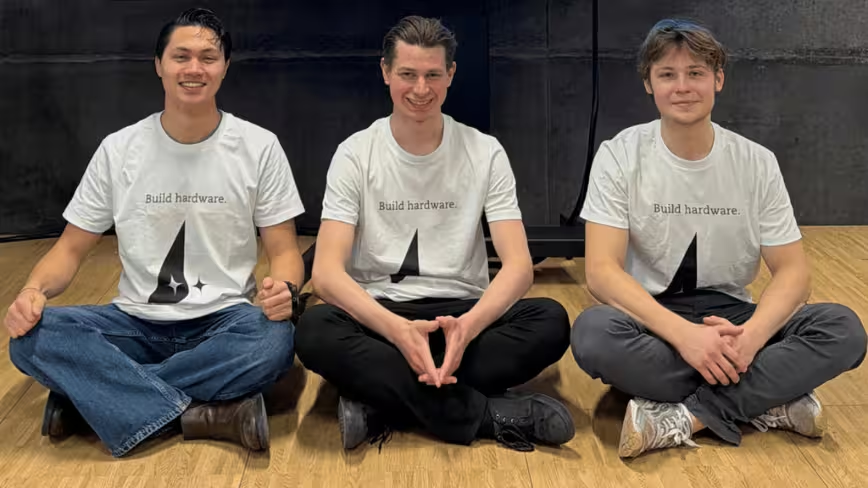
The round amount is undisclosed. Backers include Nordic Makers, Emblem, the Lovable company itself, the Sequoia Scout Fund, and the Andreessen Horowitz Scout Fund. Lovable CEO Anton Osika personally endorsed the team. Atech lets users describe a hardware concept in natural language and receive a working prototype.
Atech, a Copenhagen-based AI hardware startup, has raised an undisclosed pre-seed round from Nordic Makers, Emblem, Lovable, the Sequoia Scout Fund, and the Andreessen Horowitz Scout Fund.
Founded by Vladimir Baran (CCO), Tomas Erik Harmer (CEO), and David Stålmarck (CTO), the company is building what it calls “vibe-engineering” for hardware, a platform that lets users describe a physical device concept in natural language and receive a working prototype, with all underlying technical complexity handled by the platform.
The conceptual anchor is the parallel with what Lovable did for web application development. Lovable, the Swedish startup that allows non-developers to build full-stack web applications through natural language prompts, is valued at over $1 billion following rapid growth from its 2024 launch.
Anton Osika, Lovable's CEO, backed Atech directly and provided the company's most significant endorsement: “I am seeing the same patterns Lovable had but for hardware. I'm really excited to see Atech's journey. The team is one of a kind.”
That institutional stamp of approval, from the founder of the software-vibe-coding category, is the most newsworthy element of the announcement and frames Atech explicitly as the hardware equivalent of an already-validated category.
The problem Atech is addressing is genuine and well-documented. Building a hardware prototype has traditionally required either years of specialised engineering expertise or significant capital to hire that expertise.
A developer can build and deploy a web application in a weekend using modern tools; the equivalent end-to-end hardware experience does not exist. This asymmetry has kept hardware innovation concentrated among a small group of specialists and within well-capitalised companies, while software development has been progressively democratised over the past decade through layers of abstraction that removed the need to understand compilers, memory management, or network protocols.
Harmer, Atech's CEO, described the gap: “Software has an entire stack of tools that lets a teenager build an app in a weekend, hardware doesn't, and we're still working at the first level of abstraction. Atech is building the missing layers, so creating in the physical world can feel as fast and joyful as writing code.”
The investor syndicate is notable for a pre-seed round and warrants careful characterisation. The Sequoia Scout Fund and the Andreessen Horowitz Scout Fund are scout programmes operated by Sequoia Capital and a16z respectively, through which scouts, typically founders and operators in the funds' networks, make small investments (often $5,000 to $100,000) in early-stage companies on behalf of the firm.
Scout fund participation does not constitute a direct investment by Sequoia or a16z in the traditional sense, and does not imply follow-on commitment from the parent firms. For Atech, the value of scout participation is primarily signalling, proximity to two of the world's most prominent venture capital firms, rather than the capital amount itself.
Nordic Makers is a Copenhagen-based angel investor collective with deep ties to the Danish and broader Nordic startup ecosystem. Emblem is a European seed fund.
Lovable's participation as a corporate backer, rather than just as an endorser, gives the round a strategic dimension: Lovable has a direct commercial interest in seeing hardware development democratised, as it would expand the surface area for Lovable-style interfaces.
The broader thesis Atech is operating within, which the company refers to as “Physical AI”, is gaining traction across the industry. Nvidia's 2025 annual report framed Physical AI as its next major market opportunity: intelligent systems that sense, interact with, and act upon the physical world, including robotics, autonomous vehicles, drones, and industrial systems.
As these applications proliferate, the ability to rapidly prototype physical hardware becomes a competitive capability rather than a niche skill.
Whether a natural-language-to-prototype platform can genuinely close the hardware-software gap depends on how far the abstraction stack Atech is building can reach: PCB layout, component selection, firmware, and manufacturing considerations are all domains where the penalty for getting things wrong is a physical object that does not work, not a bug fix pushed in a pull request.
That is a harder problem than Lovable solved, and it is the question the company's first customers will answer.