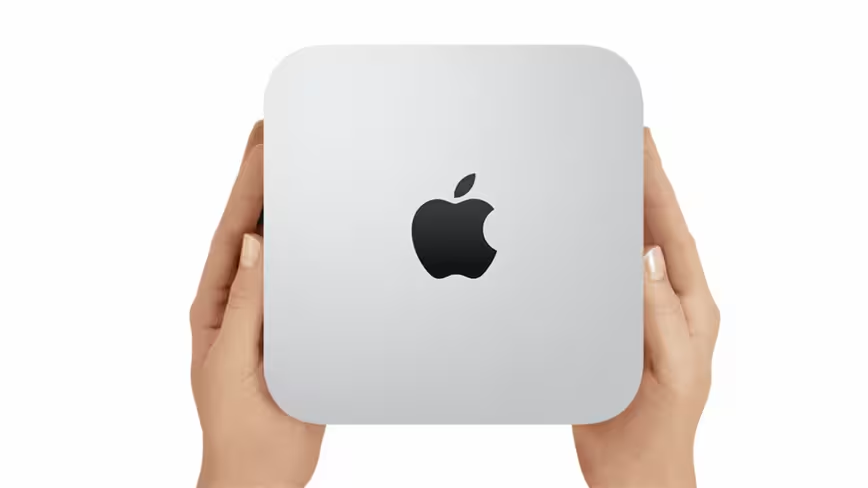
For five years, the Mac mini has been the cheapest way into Apple's desktop ecosystem. Since the M4 refresh in late 2024, that price has been $599, an unusually aggressive figure for Cupertino, and one that turned the small aluminium box into a sleeper hit.
It became the recommended starter Mac, the home-server-of-choice for tinkerers, and, increasingly, the go-to local machine for developers running AI models on their own hardware.
As of Friday, the $599 Mac mini no longer exists.
Apple has discontinued the 256GB configuration of the M4 Mac mini and made the 512GB model, which sells for $799, the new starting point. Bloomberg reported the change first, citing Apple's own product pages, with confirmations following from MacRumors, 9to5Mac, Macworld, and AppleInsider. The pricing on each specification has not changed; the entry rung has simply been removed.

The 💜 of EU tech
The latest rumblings from the EU tech scene, a story from our wise ol' founder Boris, and some questionable AI art. It's free, every week, in your inbox. Sign up now!
In effect, the Mac mini is $200 more expensive to buy in its base form than it was a day earlier.
Apple's reasoning was made unusually explicit on this week's Q2 earnings call. Tim Cook, the company's chief executive, attributed shortages of both the Mac mini and the more powerful Mac Studio to demand that had outpaced internal forecasts, and tied that demand directly to AI workloads.
Both machines, he said, are “amazing platforms for AI and agentic tools, and the customer recognition of that is happening faster than what we had predicted.”
That recognition has a specific shape. The Mac mini and Mac Studio share a feature that has, in 2026, become unexpectedly valuable: large amounts of unified memory directly accessible to the GPU and Neural Engine on Apple's M-series chips.
For developers running local large language models, agentic tools that orchestrate multi-step tasks on a single machine, or compact research setups that would otherwise require cloud GPUs, that memory architecture is a meaningful advantage. A 64GB Mac Studio costs less than the cheapest Nvidia H100, runs quietly on a desk, and does not bill by the hour.
The result has been the kind of run on inventory that hardware companies usually associate with launches, not nine-month-old products. Many higher-RAM configurations on Apple's online store are listed as currently unavailable. The 16GB, 512GB Mac mini, the new entry-level model, is, by some retail accounts, backordered into June.
Behind the consumer-facing story is a less visible one about supply. The same advanced memory chips that ship in Mac minis and Mac Studios are also a critical input for the AI server farms being built by hyperscalers, and the imbalance between data-centre demand and global memory production has been intensifying for more than a year.
DRAM prices have risen sharply, and analysts have begun warning that consumer electronics manufacturers will increasingly find themselves second in line behind cloud providers willing to pay above market.
Cook acknowledged the constraint on the call, telling investors that supply-demand balance for both machines is “several months” away. He stopped short of predicting further price changes, but Notebookcheck and others have noted that the pattern, AI demand absorbs memory, memory becomes scarcer, consumer prices rise, is unlikely to be unique to Apple.
There is also a US manufacturing dimension to the story. The M4 Mac mini is one of the products Apple has begun assembling in part within the United States, and analysts at Technetbook and elsewhere have argued that some of the cost pressure on the entry tier reflects that shift rather than chip availability alone. Apple has not commented publicly on the relative weights of the two factors.
For most consumers, the change is a soft price rise dressed up as a product simplification. The 512GB Mac mini that used to be a $200 upgrade is now the floor. Anyone who would have bought the 256GB version, students, second-machine buyers, light office users, now pays more for storage they may not need.
For the segment Apple appears to be courting, the developer running Claude- or Llama-class models locally, the new entry tier is closer to a sensible minimum. 256GB of storage was always cramped for that workflow, and 512GB combined with 16GB of unified memory is a more honest starting point.
Either way, the broader signal is harder to miss. Apple, a company that historically holds prices steady through chip cycles, has just lifted a starting price by a third in response to AI-driven demand. The Mac mini is no longer a sleeper. It is, briefly and inconveniently, an AI workstation.