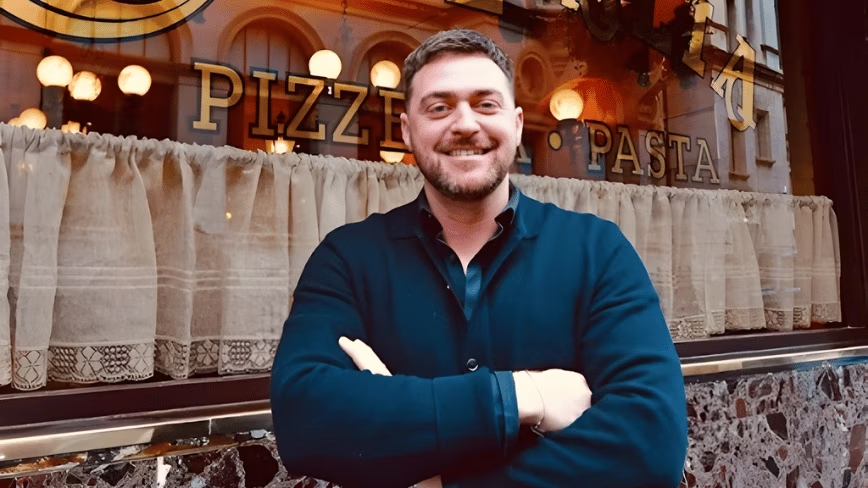
Hospitality has long been defined by human interaction, but the systems that support those interactions have undergone continuous change. Arran Campolucci-Bordi, owner of Casa Italia, established 50 years ago in Liverpool, UK, frames this evolution through lived experience, tracing a path from handwritten reservation books to digital booking systems and now toward AI-driven operations. In his view, each transition reflects a broader shift in how restaurants manage time, communication, and customer expectations.
He points out that earlier generations relied entirely on manual processes. Reservations were written down, availability was checked by hand, and customer inquiries were handled individually. As digital tools emerged, many of these processes moved online, creating greater structure and consistency. According to Arran, the current phase introduces a new layer, where systems are capable of responding dynamically to customer needs without requiring human input.
From his perspective, AI within hospitality is best understood as an operational support system rather than a replacement for people. He explains that Ayra functions similarly to a trained staff member in specific contexts, particularly when it comes to handling information. Once it has been provided with details such as menus, booking systems, and policies, it can respond to customer inquiries in a conversational format. This includes tasks such as checking availability, managing reservations, and answering common questions in real time. He suggests that, in practice, this allows businesses to handle external interactions consistently, while allowing the staff to be focused on where it matters most.
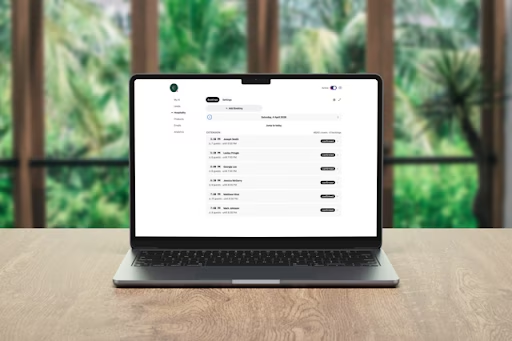
That operational shift is increasingly visible across different industries. According to a report, 58% of employees surveyed say they are already saving time at work through AI tools, with users reporting an average of 52 minutes saved per day, or nearly five hours per week. In a sector like hospitality, where a large share of time is spent responding to enquiries and managing bookings, these time savings can accumulate quickly and better influence where teams focus their efforts.
Arran emphasizes that this type of system is designed to operate alongside existing teams. He notes that many roles within hospitality involve repetitive administrative tasks that take time away from direct customer engagement.
Building on this, he explains that redistributing that time can reshape how service is delivered inside the restaurant itself. “By shifting those tasks to an AI-driven interface, businesses can allow staff to focus on delivering service within the physical environment of the restaurant,” he says. “It is a way of aligning people with the aspects of their roles that require attention, awareness, and interpersonal interaction.”
The practical implications of this shift are closely tied to how restaurants allocate their time and resources. According to Arran, a significant portion of operational inefficiency comes from fragmented communication, particularly when customers reach out with similar questions or booking requests. “Each individual interaction may be brief, but collectively they represent a substantial time commitment,” he notes. Ayra, he explains, can handle these interactions 24/7, in turn increasing time spent with customers and capturing potential missed opportunities.
This perspective also reflects broader changes in customer behavior. “As digital communication has become more immediate, expectations around response times have shifted accordingly,” Arran notes. “Customers increasingly expect quick and accurate answers, whether they are making a reservation or asking about menu options. Systems that can respond instantly help meet those expectations while maintaining clarity and consistency in communication.”
A common misconception is that hospitality is slow to adopt new technology due to the human-centric nature of the business. According to Arran, the immediate and drastic implications of adopting supposedly “robust” technology stem from the industry's failure to adequately vet what they adopt
He also highlights the importance of simplicity in adoption. From his experience, one of the main barriers for restaurant owners is not necessarily resistance to technology itself, but uncertainty about how it works in practice. As a result, the platform he has developed is designed to be robust, accurate, and straightforward to implement, only requiring businesses to provide a small amount of information to train their AI agent. Once that information is in place, the system can begin operating autonomously.
This approach reflects a broader shift in how technology is being integrated into traditional industries. Rather than requiring businesses to fundamentally change their operations, tools are being developed to fit within established structures. Arran suggests that this compatibility is essential for long-term adoption, particularly in sectors where consistency is key.
Looking ahead, he sees AI as part of an ongoing progression rather than a final destination. The transition from manual processes to digital systems has already reshaped hospitality operations, and the introduction of AI represents another stage in that evolution. Each phase, he notes, has introduced new efficiencies while maintaining the core objective of serving customers effectively.
“People come into a restaurant for the experience, and that will always be the case,” Arran says. “If technology can take care of everything around that, it allows the staff to focus on what they do best, giving customers the best possible experience.”