TL;DR
An Ahrefs study of 75,000 brands found YouTube mentions are the strongest correlated signal for AI visibility across ChatGPT, Google AI Mode, and AI Overviews, outperforming backlinks, domain authority, and content volume. Traditional SEO metrics showed surprisingly weak correlations.
A study of 75,000 brands by SEO platform Ahrefs has found that YouTube mentions are the strongest correlated signal for whether a brand appears in AI-generated search results, outperforming every other factor the researchers tested across ChatGPT, Google AI Mode, and Google AI Overviews.
YouTube mentions, defined as any time a brand name appears in a video title, transcript, or description, showed a Spearman correlation of approximately 0.737 with AI visibility. That figure was consistent across all three platforms. YouTube mention impressions, which weight those mentions by the number of views each video received, came in slightly lower at roughly 0.717.
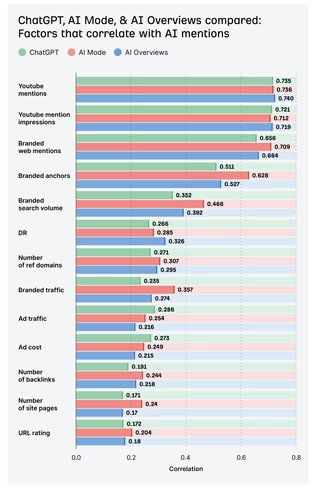
YouTube mentions correlate strongest with AI brand visibility
Both YouTube metrics beat branded web mentions, which had previously topped Ahrefs' rankings in an earlier version of the study and still showed strong correlations of between 0.66 and 0.71. The gap is notable because it means frequency of mention on YouTube matters more than the reach of those mentions, and more than being discussed anywhere else on the web.
The finding that volume outweighs reach has practical implications. Brands do not appear to be at a significant disadvantage if they are mentioned in low-view videos, as long as they are mentioned widely. A niche product reviewed by twenty small creators may register more strongly with AI systems than one featured in a single viral video.
The researchers used Ahrefs' Brand Radar tool to analyse millions of AI responses across the three platforms, filtering for domains with a domain rating above 40 and at least one keyword with 800 or more monthly searches. The study used the Spearman correlation coefficient, and the authors note that correlation does not equal causation.
YouTube's dominance makes sense when you consider the training data. Both Google and OpenAI have used YouTube transcripts to train their models. The New York Times reported that OpenAI's GPT-4 was trained on more than a million hours of YouTube transcriptions. Google's AI Mode, which crossed one billion monthly users this year, cites YouTube more than any other domain. YouTube data is baked into both the input and output of the AI systems that now shape how people discover products and services.
The study also found that traditional SEO metrics carry surprisingly little weight in AI visibility. The number of backlinks a site has showed a weak correlation, and the number of pages on a site, a rough proxy for content volume, showed almost no relationship at all, with a correlation of approximately 0.194. Domain rating, the standard measure of a website's authority, hovered between 0.266 and 0.326 depending on the platform.
This undercuts a growing recommendation in the SEO industry that brands should invest in programmatic content, automatically generating large volumes of pages to increase AI visibility. The data suggests that churning out content for volume's sake does not move the needle. What matters is being mentioned across a broad scope of sites, not publishing more pages on your own.
The three AI platforms showed distinct patterns in how they weight other signals. Google's AI Mode showed the strongest correlations with traditional brand authority signals, including branded anchors (0.628), branded search volume (0.466), and branded web mentions (0.709). It acts as what the researchers call a consensus engine, recommending brands that most people already know and search for. For emerging brands without household name recognition, AI Mode looks like the hardest platform to break into.
ChatGPT sits at the other end. It showed the weakest correlations with nearly every traditional authority metric, from branded anchors to domain rating to backlinks. The researchers suggest this makes ChatGPT the most accessible entry point for newer brands, since it appears less heavily gated by the signals that favour established players. Interestingly, ChatGPT also showed the closest correlation with advertising metrics, not because it rewards ad spend directly, but because brands that advertise heavily tend to dominate the kind of content ChatGPT draws on.
AI Overviews, Google's one-shot factual answers, showed the highest correlation with domain rating among the three platforms, though the difference was modest. The researchers speculate that because AI Overviews deliver a single answer with limited context, they may favour high-authority sources slightly more as a safety mechanism.
Despite these differences, the same brands generally dominate across all three platforms. The output overlap correlation between them was 0.779, meaning that while the paths differ, AI Mode might weight branded anchors and AI Overviews might care more about domain rating, the destinations are largely the same. Nike, Apple, and Amazon still come out on top.
The study lands at a moment when the marketing industry is scrambling to understand how AI search is reshaping brand discovery. Semrush has repositioned its entire product as a brand visibility platform for the AI era. Zero-click searches, where users get answers from AI without visiting any website, now account for roughly 60% of all Google queries. The shift from ranking on a search results page to being mentioned in an AI-generated answer is the defining transition in digital marketing.
Ahrefs' data points to a clear hierarchy for brands trying to navigate that transition: YouTube presence and web mentions matter most, followed by branded anchors and search volume. Traditional link building and content volume matter least. The implication is that brand building, getting people to talk about you in places AI systems pay attention to, has overtaken technical SEO as the primary lever for search visibility.
For marketers, the practical takeaway is that YouTube strategy is no longer optional. If the strongest signal for AI visibility is how often your brand appears in video titles, transcripts, and descriptions across the platform, then every brand needs a presence there, whether through its own channel, creator partnerships, or earned mentions in review and comparison content. The brands that AI recommends are the ones that people are already talking about on video, and that feedback loop is only going to intensify as AI search becomes the default way consumers discover products.