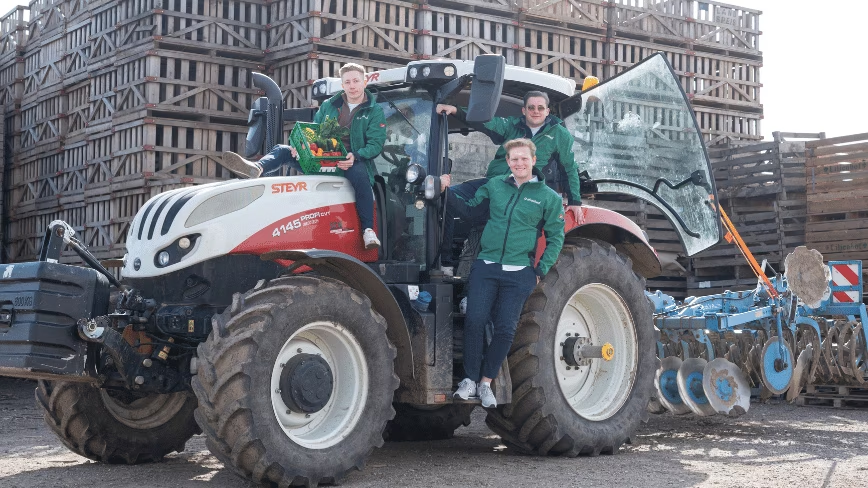
German consumers throw away 4.4 million tonnes of food every year, worth roughly €6 billion. Austrian startup Afreshed just bet that the solution is consolidation, not competition, acquiring Munich-based rival Etepetete and raising a mid-seven-figure sum to take its organic rescue-box model across the border.
The deal, announced on Monday, unites the two largest “ugly produce” subscription services in the German-speaking world. Afreshed, founded in 2021 in Linz by Lukas Forsthuber, Bernhard Bocksrucker, and Maximilian Welzenbach, sells boxes of organic fruit and vegetables that fail to meet the cosmetic standards of conventional retail, bent carrots, undersized apples, oversized courgettes. The model proved out faster than most direct-to-consumer food plays: the company hit €4.7 million in revenue by 2023, was targeting eight figures for 2024, and says it has reached break-even in its home market.
Etepetete, which has been running a near-identical operation out of the Munich Wholesale Market since 2015, brought its own track record. Founded by Georg Lindermair, Carsten Wille, and Christopher Hallhuber, the company had delivered more than 250,000 boxes and rescued upwards of 1.5 million kilograms of produce before the acquisition. In 2023, it raised €1.79 million through a crowdfunding round on Econeers, backed by 812 private investors.
Why acqui-hire beats head-to-head competition
The strategic logic is straightforward. Afreshed with its technology-first approach to operations dominates Austria with a nationwide delivery network, its own fleet of roughly 20 vehicles, and proprietary route-planning software designed to minimise last-mile emissions. What it lacked was a foothold in Germany, a market roughly ten times the size. Etepetete, meanwhile, had customers in all 16 German states, with particular density in Baden-Württemberg, Bavaria, and Berlin, but appeared to have stalled after its crowdfunding round, with no subsequent institutional funding announced.

The 💜 of EU tech
The latest rumblings from the EU tech scene, a story from our wise ol' founder Boris, and some questionable AI art. It's free, every week, in your inbox. Sign up now!
“The founding philosophy of both companies is essentially the same,” Forsthuber said in a statement. Rather than spend years and capital building a German customer base from scratch, Afreshed bought one. Co-founder Bocksrucker confirmed that Etepetete will continue as a separate brand, calling the acquisition “the first of further such moves” and stating the goal of becoming “the leading provider of rescued food in German-speaking regions.”
The acquisition price was not disclosed.
Raiffeisen-Holding enters the picture
The deal was accompanied by a more consequential piece of corporate engineering. Raiffeisen-Holding Niederösterreich-Wien, one of Austria's largest diversified holding companies, is taking a 25.1 per cent stake in Afreshed. The investment, described only as mid-seven figures, will fund the Germany expansion and further technology development.
The stake places Afreshed alongside some significant portfolio neighbours. Raiffeisen-Holding's “Food & Beverages” division already includes Agrana, the publicly listed sugar, starch, and fruit-processing group, and Neoh, the sugar-free confectionery startup that took its own mid-seven-figure investment from the holding company. Raiffeisen and Agrana also jointly committed €5 million to FoodLabs, a Berlin-based venture fund with more than 60 food-technology companies in its portfolio.
For Afreshed, the signal matters as much as the capital. A strategic investor with deep ties to Austria's agricultural supply chain lends credibility that a financial VC alone could not provide. It also suggests that Raiffeisen sees the rescue-box model not as a niche sustainability play but as a viable distribution channel within the broader food system.
The structural problem these companies exploit
Fresh fruit and vegetables account for a disproportionate share of avoidable household food waste across Europe, roughly 35 per cent, according to the figures Afreshed cites, with EU-level research placing fruit and vegetables at close to half of all food discarded by households by mass. The waste occurs at both ends of the chain: retailers reject produce that fails cosmetic standards, and consumers over-purchase and under-consume perishables.
Rescue-box companies attack the supply side of that equation, buying produce that farmers would otherwise plough back into the field or send to biogas facilities. The economics can work because the raw-material cost is substantially lower than conventional wholesale, while the subscription model provides predictable demand that simplifies logistics.
But the model has limits. Imperfect Foods, the highest-profile US equivalent, was acquired by Instacart in 2022 after struggling with unit economics at scale. Oddbox, a London-based competitor, has raised £16 million but remains confined to the UK. The pattern across the sector has been similar: strong early growth fuelled by sustainability-conscious consumers, followed by the hard work of making last-mile delivery profitable.
What happens next
Afreshed's stated ambition is pan-DACH dominance, Germany, Austria, and Switzerland. The Etepetete deal delivers immediate presence in Germany, but converting an acquired customer base into a profitable operation is a different challenge. The company will need to replicate the logistics infrastructure it built in Austria, where its own fleet and route-optimisation software form what it describes as the core of the business.
The broader context is a European startup ecosystem where consolidation is accelerating. M&A transaction volume in Europe's growth-company segment more than doubled in 2025, as rising interest rates and tighter capital markets made organic growth more expensive than buying competitors. In food technology specifically, the survivors of the post-pandemic funding pullback are now acquiring the companies that did not secure follow-on financing.
Whether Afreshed can scale the model profitably across three countries remains to be seen. But in a sector littered with subscription food companies that burned through venture capital chasing growth, a break-even Austrian operator buying a customer base rather than building one is at least a different playbook.