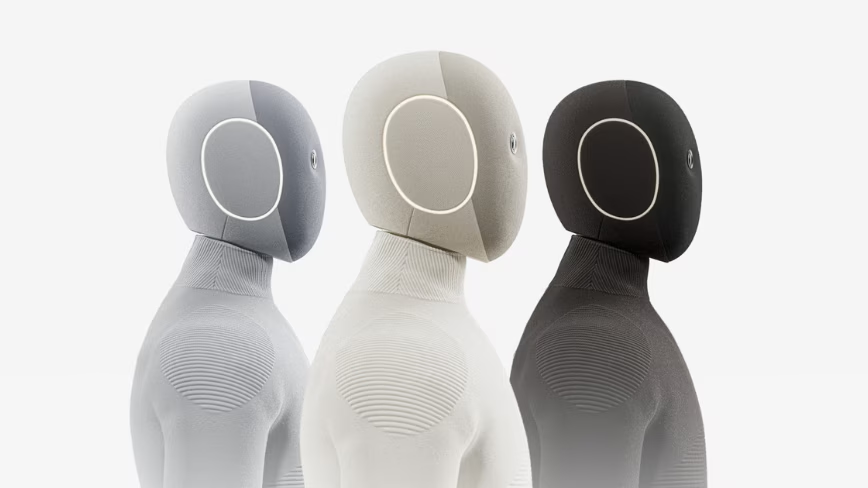
1X Technologies has opened a 58,000-square-foot manufacturing facility in Hayward, California, to produce its NEO humanoid robot at consumer scale, with capacity for 10,000 units in year one and a target of more than 100,000 units annually by the end of 2027.
The Norway-founded, OpenAI-backed company described the plant as the first vertically integrated humanoid robot factory in the United States. First customer shipments are planned for 2026.
The factory currently employs more than 200 staff and is scaling. NEO is being manufactured with critical components built in-house, motors, batteries, structures, transmission systems, soft goods, and sensors, in a configuration the company describes as bottom-up American manufacturing.
“This is more than just a factory opening, it's proof that the future of humanoid robotics is being built right here in the U.S.,” 1X CEO and founder Bernt Børnich said in the announcement.
The Hayward facility is intended as a stepping stone to a larger plant under construction in San Carlos, California.
The product
NEO is positioned as a general-purpose home robot, designed to operate alongside humans in domestic environments rather than as an industrial bipedal for warehouses or factory floors.
The robot is available in three colours (Tan, Gray, and Dark Brown) and offered through two commercial models: an Early Access purchase at $20,000 with priority delivery in 2026, or a subscription at $499 per month.
NEO is powered by Nvidia's Jetson Thor onboard computing platform and trained using Nvidia's Isaac open robotics simulation framework.
Demand has reportedly outstripped initial expectations. The company says first-year production capacity sold out within five days of preorders opening in October 2025.
1X raised $100 million in its push to bring NEO to market; the robot is designed with explicit safety constraints: it is light, soft to the touch, and configured without pinch-points or other hazards, a deliberate choice given the company's ambition to deploy in private homes rather than industrial settings, where heavier and harder humanoids dominate.
NEO learns household tasks through embodied AI, the technique under which robots acquire skills by interacting with their environment. Customers can also manually demonstrate tasks using a VR headset and controllers, and the robot includes conversational functionality that Børnich has compared to ChatGPT.
Whether those capabilities translate to reliable performance across the variety of unstructured tasks a real home presents, the open question for every consumer humanoid, is something the customer shipments later this year will start to answer.
Two routes to market
Beyond the consumer product, 1X has structured its commercial strategy around a parallel enterprise track. In December 2025, the company struck a partnership with private equity firm EQT to deploy up to 10,000 NEOs to companies in EQT's portfolio between 2026 and 2030 across facility operations, manufacturing, logistics, and healthcare.
The two-track structure gives 1X higher-margin enterprise revenue from its early units, plants and warehouses pay full price for performance, while the home model can scale down in cost over time. It is the same playbook electric vehicles followed, with luxury and commercial customers subsidising the consumer rollout.
The 10,000-unit annual production target is a meaningful number in a field where most humanoid robot makers are still measured in the hundreds. Tesla, however, is the comparison that matters most. Tesla's China president Wang Hao described the Shanghai Gigafactory as a “golden key” to mass-producing the company's Optimus humanoid robot. Tesla has discussed manufacturing a few hundred Optimus units in 2026, scaling to thousands and then tens of thousands annually by 2027 and 2028, with internal targets of one million units per year from Shanghai that have not been confirmed in any public filing.
Elon Musk's long-stated goal is pricing Optimus below $20,000 per unit, the same price point at which 1X is selling Early Access NEOs today.
China's humanoid robotics sector is moving rapidly in parallel. Unitree's G1 and H1 robots are commercially available at price points well below Tesla's indicated targets. Agibot, UBTECH, Fourier Intelligence, and a growing roster of Chinese startups are all targeting the same market.
China's central and local governments have identified humanoid robots as a strategic technology, with subsidies and policy support that other regions have been slower to match. The competitive dynamic places 1X's American-manufactured, vertically integrated approach against Chinese state-backed scale and Tesla's automotive manufacturing infrastructure simultaneously.
Europe is also building. Neura Robotics, founded in Germany in 2019, has scaled to more than 600 employees and raised €120 million in January 2025. Founder David Reger has told TNW he sees Tesla as his only real competitor in the segment.
Europe's humanoid robotics sector is positioning regulatory clarity, the AI Act, the updated Product Liability Directive, the General Product Safety Regulation, and the Machinery Regulation, as a competitive advantage, on the argument that investors and industrial partners commit resources where compliance risks are predictable.
The factory opening is the easy part. Manufacturing a humanoid robot at scale, while difficult, is fundamentally a known engineering problem with known suppliers and known cost curves. The harder question, the one no manufacturer has yet definitively answered, is whether a general-purpose home robot can perform the variety of unstructured tasks a private home demands at a level customers will pay $20,000 or $499 a month for.
1X's answer to that question is, in part, to ship and iterate. Robots produced at the Hayward facility are currently being routed to internal testing, validation, and the company's own R&D Lab and Internal Home Testing programmes before customer deliveries begin.
The vertically integrated manufacturing approach was chosen specifically to enable rapid hardware iteration as feedback comes in. If that iteration speed is fast enough to close the gap between the demonstrations on the launch reel and the messy reality of the average American home is, ultimately, the bet behind the entire factory.